Electronic Payment Systems in Saudi Arabia: Types, Benefits and How They Work
Electronic payment systems are the set of entities and technologies that move money from the customer’s account to the merchant’s account after the customer taps “Pay”. In Saudi Arabia they work on two layers: national infrastructure supervised by the Saudi Central Bank, and acceptance solutions merchants use directly, such as gateways and payment links. This article explains the national systems, the types of acceptance systems available to merchants, the stages of a single transaction, their benefits, and how your business connects to them through Tuwaiq Pay. If you prefer to start right away, you can also visit the official Tuwaiq Pay website, contact us on WhatsApp, or download the app from Google Play or the App Store.
What Is an Electronic Payment System?
It is a system made up of several parties working together to complete a single transaction: the customer who pays, the merchant who receives, the bank that issued the customer’s card, the payment service provider that receives the transaction on the merchant’s behalf, the network that connects these parties, and the regulator that sets the rules. The better you understand each party’s role, the easier it is to choose the right solution for your business and to understand what is happening when a transaction is declined or delayed.
Which National Systems Make Up Electronic Payments in Saudi Arabia?
Electronic payment systems in the Kingdom rest on national infrastructure supervised by SAMA. The most important ones for merchants are:
| System | Function | Relevance to merchants |
|---|---|---|
| mada | The national network for bank cards across ATMs, points of sale and online payments | Merchants accept it through their payment provider, and it is widely used by customers |
| SADAD | A national system for paying bills electronically | Serves bill payments and is not a way for stores to accept payments |
| sarie instant payments | A system launched by the central bank to transfer money between accounts instantly | Relevant to those receiving direct transfers from customers’ accounts |
| SARIE for settlement | The Saudi Arabian Riyal Interbank Express system, which settles amounts between banks | Works behind the scenes and affects how long funds take to arrive |
You will find a fuller explanation of real-time transfers in our article on how instant payment processing works. Names and detailed descriptions may change, so refer to the websites of the Saudi Central Bank and Saudi Payments.
What Types of Electronic Payment Systems Do Merchants Use?
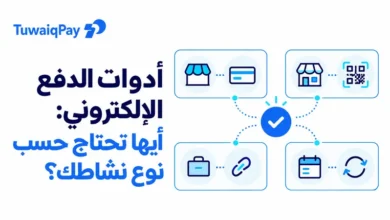
The best acceptance system depends on how you sell. The table shows the main types and their status with Tuwaiq Pay:
| Type | How it works | Best for | With Tuwaiq Pay |
|---|---|---|---|
| Payment gateway for stores and websites | Payment methods appear on the checkout page through an API integration | Online stores | Available |
| Payment links and invoices | The merchant sends an invoice link by WhatsApp, text message or email | Freelancers and selling through chats | Available |
| QR code | The customer scans it and completes payment | Shops and in-person services | Available, linked to the invoice |
| Digital wallets | The customer confirms payment from their phone wallet | Stores in general | Apple Pay supported |
To learn how these methods differ from the customer’s side, see our article on electronic payment methods in Saudi Arabia.
How Do Electronic Payment Systems Work, Step by Step?
A single transaction passes through six stages, usually within seconds:
- Request: the customer chooses a payment method and confirms the amount.
- Verification: the system verifies the customer’s identity, including 3D Secure via a code sent to their phone.
- Authorization: the system sends the request to the issuing bank to confirm funds are available.
- Approval or decline: the bank responds, and the result appears to the customer and the merchant.
- Clearing: successful transactions are grouped and the amounts owed between parties are calculated.
- Settlement: the money actually moves, and the net amount is transferred to the merchant’s bank account.
How does an online payment gateway work?
The gateway is the intermediary that carries out the first four stages on your behalf: it securely receives the customer’s payment details, communicates with the network and the bank, then returns the result to you. It is different from the national system: the gateway is a tool for accessing the systems, not a replacement for them.
When does the money reach your account?
With Tuwaiq Pay, settlement takes one to five days depending on the card network and the transaction. mada transactions usually arrive within about 48 hours, and Visa and Mastercard transactions within about 24 hours, after which the amount is transferred automatically to your bank account.
If you want to try these systems yourself, download the Tuwaiq Pay app and create your first invoice.
How Do You Choose the Right Electronic Payment System for Your Business?
Start with one question: where do you sell? If it is in an online store, a payment gateway connected to it is the right choice. If it is on WhatsApp and Instagram, a payment link or invoice is faster and simpler. If it is in a shop or an in-person service, a QR code linked to the invoice is usually enough. Then review three things before deciding: the payment methods your customers prefer, the settlement period, and the full cost including VAT. You can combine more than one system in a single business, such as an online store plus payment links for special orders.
What Are the Benefits of Electronic Payment Systems for Merchants?
- Faster collection: the customer pays as soon as they receive the link or reach the checkout page.
- Clear tracking: every transaction is recorded with its time and amount, making reconciliation easier.
- Less cash handling: and the errors, deposits and deliveries that come with it.
- Access to online customers: you can sell to people who never visit your shop.
- Easy expansion: add new methods and channels without changing your business.
- Flexible refunds: you can refund the amount in full or in part when needed; for more, see our article on refunding payments.
How Are Electronic Payment Systems Secured and Regulated?
The Saudi Central Bank supervises payment systems in the Kingdom and sets their rules. At the merchant level, protection rests on three elements: verifying the customer through 3D Secure, replacing card data with substitute tokens (tokenization), and compliance with the PCI DSS card data security standard. Tuwaiq Pay supports these elements in its technical integration solutions and complies with PCI DSS standards. Regulatory requirements may change, so it is best to refer to official sources.
How Does Your Business Connect to These Systems Through Tuwaiq Pay?
Tuwaiq Pay provides the link between your business and these systems without complexity:
- Payment links and QR codes: create an invoice in the app and send it, with no store and no developer.
- API integration: for stores and websites, with a sandbox to test the integration; the guide to connecting a payment gateway to your online store explains the steps.
- Payment methods: Apple Pay, mada, Mastercard, Visa and American Express, plus international cards provided they are enabled for online payments.
- Dashboard and notifications: real-time reports and instant notifications for every transaction, plus sub-accounts for branches and employees.
- Activation within 24 hours once the requirements are complete.
There are no setup fees, no monthly subscription and no hidden fees. Tuwaiq Pay publishes its fees excluding VAT: 1% + SAR 1 for domestic payment links and 1.2% + SAR 1 for domestic online stores, and prices may change. To learn which payment methods your customers use, see electronic payment apps in Saudi Arabia.
How Do You Get Started?
- Download the Tuwaiq Pay app and create your account.
- Enter your business details.
- Upload your documents: a commercial registration or freelance certificate, a national ID, a national address and a bank certificate or letter.
- Wait for your application to be reviewed, then sign the contract.
- Activate your account and create your first invoice.
Frequently Asked Questions
What is the difference between a payment gateway and electronic payment systems?
A payment system is the broader infrastructure that moves money between parties, such as mada and the card networks. A payment gateway is a tool merchants use to access these systems and carry out the transaction.
What is the difference between mada and instant payments?
mada is a national network for bank payment cards, while the instant payments system transfers money directly between accounts. Each has a different use.
Do I need a point-of-sale terminal to accept electronic payments?
No. Payment links and QR codes work without a device, and an online store can be connected through the API.
How long does settlement take?
One to five days depending on the network and the transaction.
Who regulates electronic payment systems in Saudi Arabia?
The Saudi Central Bank supervises payment systems and sets their rules.
Can I accept international cards?
Yes. Tuwaiq Pay supports Visa, Mastercard and American Express cards issued outside Saudi Arabia, provided they are enabled for online payments.
Conclusion
Electronic payment systems in Saudi Arabia work on two layers: national infrastructure supervised by the central bank, and acceptance solutions merchants choose based on how they sell. The better you understand the stages of a transaction, the better you can choose a solution and estimate when your money will arrive. Tuwaiq Pay brings payment links, QR codes, API integration and the main payment methods together in one app, with no setup fees or subscription. Fees and requirements may change, so always refer to the official source. To get started now, you can also visit the official Tuwaiq Pay website, contact us on WhatsApp, or download the app from Google Play or the App Store.