Digital vs. Cash Payment in Saudi Arabia: Where Is the Market Heading?
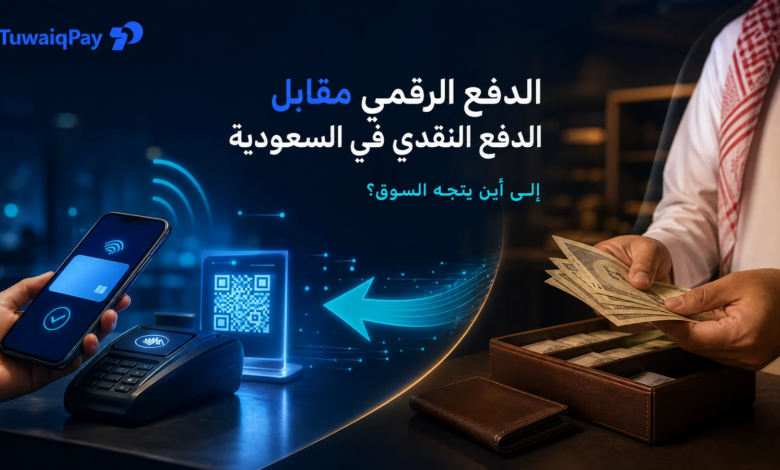
Digital versus cash payment in Saudi Arabia is no longer an even comparison. According to data from the Saudi Central Bank (SAMA), electronic payments made up 85% of all individual payment transactions in 2025, compared with 79% in 2024 and 70% in 2023, which means the balance between digital and cash payment in Saudi Arabia is tipping clearly toward digital year after year. Any merchant or freelancer can start keeping up with this shift right away. You can visit the official Tuwaiq Pay website, contact us on WhatsApp, or download the app from Google Play or the App Store.
This article reviews the official data behind digital versus cash payment in Saudi Arabia, the reasons behind this shift, whether it means cash will disappear entirely, and what this trend means for any merchant or business owner in the Kingdom.
The Share of Digital Versus Cash Payment in Saudi Arabia
According to Saudi Central Bank (SAMA) data, electronic payments made up 85% of all individual payment transactions in 2025, compared with about 70% just three years earlier. This figure actually exceeds the Saudi Vision 2030 target of raising the share of non-cash payments to 70%, a target the Kingdom reached early before the balance of digital versus cash payment in Saudi Arabia continued to tilt further toward digital. More important than the figure itself is what it means for merchants: only about one customer in seven still prefers to pay in cash, while the rest expect an electronic payment option as a given.
Why Is Reliance on Cash Declining in Saudi Arabia?
The spread of contactless payment
Saudi Arabia records some of the highest adoption rates of near-field communication (NFC) payment technology in the world, which makes paying by card or phone with Apple Pay or mada faster and easier than handling cash at everyday points of sale.
The growth of e-commerce
Every purchase from an online store is by nature a digital payment, and the continued growth of e-commerce in Saudi Arabia automatically raises the share of non-cash payments in total transactions, whether through large stores or small businesses that have moved to selling online in recent years.
Clear institutional support from Vision 2030
This shift is part of the goals of the Financial Sector Development Program under Saudi Vision 2030, which explicitly targeted reducing reliance on cash and accelerating digital transformation in payments, reflected in support for national payment infrastructure such as mada.
Easier acceptance tools for merchants themselves
The spread of simple solutions such as payment links, QR codes and phone payments (Tap to Pay) has lowered the cost and complexity of accepting digital payments, even for small merchants and freelancers. This has made it easier for merchants to move to accepting digital payments instead of relying on cash alone, without major investment in devices or complex technical infrastructure.
The Main Benefits of Moving from Cash to Digital Payment
Beyond the numbers, moving from cash to digital payment brings tangible practical benefits for any merchant or business owner, including:
Faster, more consistent collection
Instead of manually waiting to confirm a bank transfer or counting cash at the end of the day, digital payments are recorded automatically within seconds of the transaction, improving the business’s daily cash flow.
A better customer experience
Today’s customers expect to find their preferred payment option ready, whether a mada card, Apple Pay or a payment link sent directly to them. Offering this option reduces the chance of customers abandoning a purchase because a suitable payment method isn’t available.
Lower cash-handling risks
Keeping large amounts of cash in the shop or carrying it to the bank every day carries risks that don’t exist with digital payments, which are recorded and transferred electronically with no physical handling of money.
Clearer financial tracking
Every digital payment is recorded automatically with its date and value, making it easier for merchants to review their business performance, reconcile accounts and prepare reports, without relying on manual ledgers or rough sales estimates.
Greater professionalism that builds customer trust
Offering a clear digital payment method (an invoice, a payment link or an electronic receipt) gives a more professional impression of the business, compared with relying entirely on cash collection or undocumented bank transfers.
Why Is Tuwaiq Pay a Good Fit for This Shift?
As the gap between digital and cash payment in Saudi Arabia widens, choosing a payment gateway that suits the size of your business matters more than simply “having” an electronic payment method. This is exactly where Tuwaiq Pay stands out as a practical choice for any merchant who wants to start without complexity:
- No setup fees or fixed monthly subscription: the model is based on paying only for actual use, lowering the financial barrier for any business just starting out.
- Fast activation: no need to wait weeks to start receiving digital payments.
- Support for the core payment methods in the Saudi market: mada, Apple Pay, Visa and Mastercard, the same methods driving the 85% share mentioned above.
- More than one way to receive payments: payment links, QR codes and direct online store integration, suiting fixed shops, mobile merchants and freelancers alike.
- A dedicated path for individuals and freelancers: with alternative documents to a commercial registration for those without a formal business, alongside a company path for those who need it.
- Full tracking from a dashboard and mobile app: to review transactions and transfers at any time without a separate device or system.
In this way, Tuwaiq Pay’s role isn’t limited to “accepting digital payments”; it gives merchants the same tracking tools that make the move from cash to digital real in daily practice, not just a cosmetic addition.
Has Cash Payment Disappeared Completely?
No. Although 85% is a very high share, cash still makes up part of the market, especially in some small everyday transactions or among certain groups of consumers who prefer cash for personal or cultural reasons. The general trend points clearly to a further decline in cash’s share of the digital versus cash equation, but its complete disappearance is neither certain nor expected within a specific timeframe based on the data currently available.
What Does This Shift Mean for Business Owners and Merchants?
In practice, it means any merchant relying only on cash or manual bank transfers is now outside the way 85% of customers prefer to pay. This applies not only to large stores, but also to small restaurants, freelancers and service providers who deal with individual customers, regardless of business size or the city they operate in.
In practical terms, this trend has four direct consequences for any merchant:
- An online payment gateway that supports the most-used payment methods (mada, Apple Pay, Visa, Mastercard) has become essential, not optional.
- Merchants who stick to cash risk losing a growing share of customers who don’t carry cash at all or simply prefer to pay digitally.
- The easy tracking and review that electronic payments provide has become a competitive advantage in itself for running a business, compared with the difficulty of tracking cash collection manually.
- Future expansion, whether opening new branches or selling online, becomes easier when payments are digitally organized from the start rather than relying on manual solutions that are hard to scale later.
These four consequences apply not only to traditional stores, but equally to service providers and freelancers who deal directly with individual customers.
Where Is the Balance Between Digital and Cash Payment Heading Next?
Based on the trend recorded in SAMA data in recent years, and with continued institutional support under Vision 2030 for reducing reliance on cash, the share of digital payments is expected to keep rising over the coming years, although growth may gradually slow as the share approaches its practical ceiling. This is a general expectation based on the historical trend, not an official SAMA figure for any future year, and actual outcomes may differ depending on market developments or new policies.
For any Saudi merchant, this trend doesn’t seem likely to change or reverse, which makes equipping your business with a suitable electronic payment method a proactive step rather than a late reaction. You can start with an online payment gateway like Tuwaiq Pay, which supports the core payment methods in the Saudi market and offers more than one way to receive payments (payment links, QR codes and direct online store integration), with activation within 24 hours and no setup fees or fixed monthly subscription, paying only for actual use.
Frequently Asked Questions About Digital Versus Cash Payment in Saudi Arabia
What is the current share of digital versus cash payment in Saudi Arabia?
Electronic payments accounted for 85% of all individual payment transactions in 2025, according to Saudi Central Bank (SAMA) data, which means fewer than one in seven payments is currently made in cash.
Has Saudi Arabia achieved the Vision 2030 target for non-cash payments?
Yes. The current share (85%) exceeds the Vision 2030 target of raising non-cash payments to 70%, a target that was reached early, with growth continuing afterwards.
Will cash disappear completely?
Nothing confirms that so far. Although cash’s share keeps declining, some transactions and groups still partly rely on it, and the available data doesn’t point to a specific date for its complete disappearance.
Why does this trend matter to store owners and freelancers in particular?
Because not having an electronic payment method effectively excludes a large share of customers who prefer to pay digitally, whether online store customers or walk-in shoppers, making an online payment gateway an operational necessity rather than an optional extra that can be postponed.
What is the source of the digital versus cash payment statistics in this article?
All figures in this article are taken from official data published by the Saudi Central Bank (SAMA).
Conclusion
In short, the digital versus cash payment equation in Saudi Arabia has effectively been settled in favor of digital, with 85% of individual payment transactions according to SAMA’s latest official data. Cash hasn’t disappeared, but it is no longer the default option, and this shift puts any merchant still relying on it alone before a clear choice: adapt to the way Saudi customers prefer to pay today.
If your business still relies only on cash or manual transfers, the digital versus cash payment equation in Saudi Arabia shows that this shift is a good opportunity to review how you accept payments. You can start by contacting us directly on WhatsApp to find the right solution for your business.